
Why Is One Journalist Targeting Eli Savit While Ignoring Others? A Pattern That Raises Questions


In politics, scrutiny is expected. Public officials should be questioned, investigated, and held accountable. That is the role of journalism.
But what happens when that scrutiny appears to be focused on one individual over and over again while others in power seem to escape the same level of attention?
That is the question worth asking. In recent weeks, multiple articles by Detroit News journalist Craig Mauger have centered on Washtenaw County Prosecutor and Attorney General candidate Eli Savit. The headlines are striking and consistent:
Questions about donors
Allegations tied to past conduct
Reports on travel expenses
Framing that places Savit under a negative spotlight
One story can be news. Two stories can be coincidence. But a pattern of coverage begins to raise a different question: Why the sustained focus on one candidate?
At the same time, powerful figures like Michigan Attorney General Dana Nessel and Oakland County Prosecutor Karen McDonald continue to operate with far less aggressive scrutiny from the same voice.
That contrast matters. Because journalism is not just about what is reported it is also about what is not.
When coverage repeatedly highlights one target while remaining quiet or less critical toward others in similar positions of power, it creates a perception problem.
Whether intentional or not, it can look like imbalance. And in politics, perception shapes public trust.
To be clear: questioning Eli Savit is not the issue. The issue is consistency. Are all candidates being examined with the same intensity?
Are all public officials being held to the same standard?
Or are certain narratives being amplified while others remain in the background?
These are not accusations they are questions.
But they are questions that deserve answers. Because journalism carries influence.
It shapes how the public understands candidates, elections, and truth itself.
And when that influence appears uneven, people notice.
In a time when trust in institutions is already fragile, consistency in reporting is not optional it is essential.
The public does not expect perfection from journalists. But it does expect fairness.
And when fairness is in doubt, accountability must apply to everyone—including those who report the news.

Washtenaw County Prosecutor Eli Savit has repeatedly used a government gas card
to purchase fuel for his travels to and from campaign events for his bid to become
Michigan's next attorney general, according to internal county records obtained by
The Detroit News.
The News compared the location of gas stations where Savit's county government
card was used over the last 12 months with posts on his Facebook page and
elsewhere about his campaign stops, finding at least 21 instances where the
purchases matched locations Savit was campaigning.
All of those 21 locations — places where Savit's county card purchased about $838
worth of gas — were outside Washtenaw County.
Savit, who's a Democrat and was first elected Washtenaw County prosecutor in
2020, said his use of the county resources to get him to campaign stops around the
state over the last year has been legal because his county compensation package
provides him "unlimited use of a county-provided vehicle."
"Expenses related to any personal use ... are tracked and reported as 'personal,'"
Savit said Thursday. "The value of those personal trips is part of my personal
income."
Yet, it seems unlikely that some of the taxpayer-backed income Savit has received
would have happened if he weren't campaigning for a higher political office.
Michigan law bans government employees from using money or equipment to
contribute to a candidate.
Bob LaBrant, a longtime Michigan lawyer and a campaign finance expert, said Savit
should have used his personal credit card, not the county's card, to purchase gas.
"I think this is a clear example of a violation of Section 57 of the campaign finance
law, using public resources for a campaign," said LaBrant, former general counsel
for the Michigan Chamber of Commerce.
The documents obtained by The News raised new questions about Savit's work as a
county prosecutor ahead of Sunday's Democratic Party convention in Detroit, where Democrats will decide whether to nominate Savit, Oakland County Prosecutor Karen McDonald or longtime public defender William Noakes to be the state's top law enforcement official.
Michigan Attorney General Dana Nessel, a Democrat, can't run again because of
term limits.
More: Attorney general hopeful Eli Savit's travel cost taxpayers, records show

Washtenaw County Prosecutor Eli Savit said Friday he'll repay the county
government for spending on his fuel for travel across the state after The Detroit
News revealed that some of the government expenditures had directly supported his campaign for attorney general.
Twelve hours after The News Investigation was published online, tying $838 in gas
purchases to campaign events outside Washtenaw County, Savit's campaign
released a statement that said the candidate "will be voluntarily reimbursing the
county in the amount of any gas purchases he has made since he launched his
campaign."
"As a public servant, Eli has always strived to hold himself to a higher standard than
simply what is allowed," his campaign's statement said. "And Eli will always strive
to maintain the public trust. "When, upon reflection, he believes a course-correction is necessary to avoid
unnecessary questions or concerns, he will do so."
Savit's statement didn't specify the tally of how much he would repay, but it said he
would reimburse the county "in the amount of any gas purchases" he made since
That would equal about $4,644, according to an analysis of county records by The
News.
On Sunday, Michigan Democrats will gather for a convention in Detroit, where they
will decide whether to pick Savit, Oakland County Prosecutor Karen McDonald or
longtime public defender William Noakes as their nominee for attorney general.
As Washtenaw County's prosecutor, Savit has a county-provided vehicle and a
government gas card to buy fuel for the vehicle.
Internal county records that listed the locations of his fuel purchases and a review of Savit's campaign Facebook page showed at least 21 instances when the purchases
matched places outside Washtenaw County where Savit was campaigning.
Some of Savit's gas purchases using the county gas card were as far away as
Ontonagon and Iron Mountain in the Upper Peninsula, more than 500 miles away
from Washtenaw County.
Michigan law bans government employees from using money or equipment to
contribute to a candidate.
Savit, who was first elected Washtenaw County prosecutor in 2020, said his use of
the county resources to get him to campaign stops around the state over the last
year has been legal because his county compensation package provides him
"unlimited use of a county-provided vehicle."
"Expenses related to any personal use … are tracked and reported as 'personal,'"
Savit said Thursday. "The value of those personal trips is part of my personal
income."
In his campaign's Friday statement, Savit said the policy of the county prosecutor
being allowed unlimited personal travel pre-dated his being elected to the position.
"Though his use of the car for personal reasons is fully consistent with county
policies, it is fair to note that this compensation arrangement — which again,
predated his tenure — likely did not contemplate the amount of personal travel he
has done over the past year as he campaigns for AG," the statement said. "Prosecutor Savit does not want this to be a distraction from the important issues
facing Michiganders. And more importantly, he cares about honoring the spirit of
his compensation agreement." cmauger@detroitnews.com More: Washtenaw County prosecutor to repay thousands in gas purchases

Lansing — A Michigan Democrat said Monday that she voted in the April 19 state
party convention from her home in Antrim County, raising questions about whether
party rules requiring in-person voting were followed.
The Detroit convention, where Democrats endorsed candidates for attorney general, secretary of state and university board positions, was hotly contested and drew about 6,600 voting members. It's been unclear in the nine days since the event whether some candidates who lost races would publicly contest their defeats, citing potential policy missteps. Amid that uncertainty, Cathy Albro, a Democratic former U.S. House candidate
from Antrim County, told The Detroit News on Monday that she left Detroit, after
getting her credential for the convention, on the morning of April 19. When she
arrived home in Bellaire, she voted to test whether it was possible to cast her ballot
through the electronic voting system, Albro said.
A copy of the initial unofficial results reviewed by The News showed Albro's vote
counted in the races. For instance, she cast a vote for Lt. Gov. Garlin Gilchrist II in
the race for the secretary of state nomination, according to the unofficial records.
"Yeah, it did concern me," Albro said about being able to vote remotely. "If it’s easy
to breach something like that, what else is possible?” For the convention, Michigan Democrats had to become party members by March
20 to be eligible to vote. Then they had to get credentialed in person at the
convention.
After that, Michigan Democrats were supposed to receive a link to the voting system
and were supposed to be able to cast their votes through their personal phones.
However, the convention's rules required them to be present in person at the
Huntington Place convention center to participate.
Albro, who posted on Facebook about leaving the convention, acknowledged that
she checked a box, saying she was in person at the convention before casting her
vote. Albro said the party's leaders can take away her vote if they so choose.
Candidates who participated in the convention have the right to challenge votes
through an appeals process, said Derrick Honeyman, a spokesman for the Michigan
Democratic Party. The deadline for any appeals is May 4.
"Members were required to be in person at Huntington Place to credential and
vote," Honeyman said Monday.
Secretary of State candidate raised concerns about electronic voting
There were concerns about the electronic voting process before the April 19
convention. Suzanna Shkreli, a candidate for secretary of state, asked the party in
the days before the gathering to outline its plans to ensure the in-person voting
requirements were enforced and to detail its verification processes.
Liano Sharon, a progressive activist from Lansing, had also questioned the
enforcement of the party's rules.
On Monday, Sharon said he asked Albro to vote in the convention from her house to
see whether it was possible and determine whether the party's system included a
virtual perimeter to prevent votes from being submitted outside of the convention
hall. It apparently didn't.
"I've had reports from many other people who were also able to vote from home,"
Sharon said, adding that he's heard of one person who voted in the Democratic
convention from outside of the country.
However, Sharon contended that progressive members of the party showed up so
strongly for the convention that the voting questions wouldn't affect the results in
the main races.
Sharon wasn't the only Democrat who claimed to have heard about people voting
outside of the convention hall. Michelle Price-Miletic of Oakland County said she
had heard of four or five people who voted from their homes through the electronic
system.
Voting started two hours late at the convention. The gathering featured "vile"
comments against some Democrats, like U.S. Rep. Haley Stevens of Birmingham,
who's running for the U.S. Senate, and no one in leadership went on stage to stop
the anger, Price-Miletic said.
"I grew up in New York," she added. "I’ve seen crap. This was … I’ve never seen
anything like this before.”
What were the unofficial results of the Michigan Democratic Party's endorsement convention?
The Michigan Democratic Party hasn't released official results. However, according
to unofficial numbers obtained by The News on Monday, Washtenaw County
Prosecutor Eli Savit got about 59% of the vote in the attorney general race, while
Oakland County Prosecutor Karen McDonald received about 41%.
Olivia Bradish, campaign spokeswoman for McDonald, said Monday night that her team had received voting data from the Michigan Democratic Party and was still reviewing it.
“We continue to work closely with MDP Chair Curtis Hertel and his team to identify
and address all voting issues," Bradish said.
In the race for secretary of state, Gilchrist got about 58% of the vote, while Ingham
County Clerk Barb Byrum received about 22% and Shkreli, a former state lottery
commissioner, got about 20%, according to the unofficial numbers.
The race for the nomination for two seats on the Michigan State University Board of
Trustees was much closer. According to the unofficial numbers, incumbent Trusee
Brianna Scott of Muskegon got about 38% of the vote, locking up one of the spots.
Fellow incumbent Kelly Tebay received about 30.9% for the other nomination.
Tebay beat state Sen. Sylvia Santana, who received about 30.8% of votes cast, losing
by a margin of about 15 votes, according to the unofficial numbers reviewed by The
News.
For two seats on the University of Michigan Board of Regents, Regent Paul Brown
got about 44% of the vote, while challenger and Dearborn lawyer Amir Makled got
about 40%. Regent Jordan Acker of Huntington Woods finished in third place with
about 15%, according to the unofficial numbers.
cmauger@detroitnews.com
More: Michigan Democrat says she broke rules, voted in convention from home
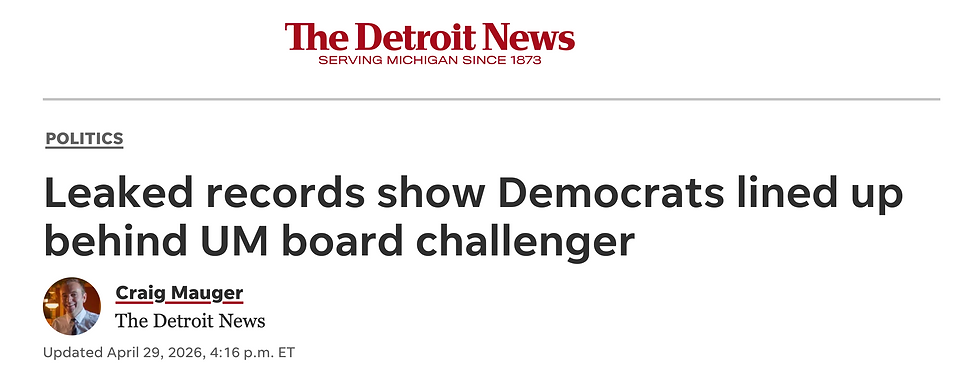
Lansing — A Democratic candidate for a seat on the University of Michigan Board
of Regents whose social media posts about Israel drew a backlash from some top
state Democrats won his April 19 convention race in overwhelming fashion,
according to internal voting records obtained by The Detroit News.
The unofficial numbers collected by the Michigan Democratic Party showed, on
average, nearly two out of every three of the 6,500 party members who voted in the
race for two seats on the UM board supported lawyer Amir Makled. High-ranking
state and congressional officials supported the two incumbents over Makled.
At the convention, Makled, an Arab-American attorney based in Dearborn,
effectively unseated Democratic incumbent regent Jordan Acker, a lawyer who's
Jewish and had been targeted by pro-Palestinian demonstrators who wanted the
university to divest from its endowment companies contributing to Israel's war
against Hamas in Gaza. More: Leaked records show Democrats lined up behind UM board challenger

Lansing — Three Michigan Democrats, including Attorney General Dana Nessel,
are calling for an audit of their party's April 19 convention results, citing problems
with the way votes were submitted and counted at the gathering of thousands of
party members.
Over the weekend, state Sen. Sylvia Santana appealed her narrow loss in a race for a
seat on the Michigan State University Board of Trustees and said the state
Democratic Party's leadership didn't enforce a rule requiring people to be in person
at the meeting to vote.
The 53-page filing from Santana's campaign contended there were "material errors"
in the convention's vote-counting process and requested an audit of all the results
by an outside firm. According to unofficial numbers, previously obtained by The
Detroit News, Santana finished in third place by about 15 votes for the second of
two nominations for the MSU board.
The submission from Santana, a Detroit Democrat, put a brighter light on concerns
from some in the party about how the electronic voting system, involving attendees'
personal cellphones, functioned at the convention. Santana's campaign said it
reviewed location data for devices used in voting and found more than 200 votes
were cast remotely, from outside Detroit's Huntington Place convention center.
"Petitioners learned that members were voting from as far away as Montenegro and
Antrim County during the convention," Santana said in her filing.
More: Michigan Democrat says she broke rules, voted in convention from home
Last week, Cathy Albro, a Democratic former U.S. House candidate from Antrim
County, told The Detroit News she was able to cast her vote in the Detroit
convention through the electronic voting system from her home in northern
Michigan.
Michigan Democratic Party convention rules required members to be present at the
convention at the time they voted in order to participate. If those 200 votes weren't
counted, Santana would win by 50 votes, her campaign argued.
The unofficial results, reviewed by The News, showed incumbent MSU Trustee Kelly Tebay coming in second place, 15 votes ahead of Santana. According to the
unofficial numbers, incumbent Trustee Brianna Scott of Muskegon finished in first
place with about 38% of the vote. Tebay and Santana each got about 31%.
Santana's filing goes to the Michigan Democratic Party's Appeals Committee. She
requested an audited recount in all the convention races to "ensure voter confidence
in the election results."
That would include, if honored, the races for the party's nominations for attorney
general and secretary of state. Under the current results, Washtenaw County
Prosecutor Eli Savit won the attorney general nomination with about 59% of the
vote, while Oakland County Prosecutor Karen McDonald received about 41%.
In the race for secretary of state, Lt. Gov. Garlin Gilchrist II got about 58% of the
vote, while Ingham County Clerk Barb Byrum received about 22% and Shkreli, a
former state lottery commissioner, got about 20%, according to the unofficial
numbers.
In a statement Monday, McDonald endorsed Santana's call for an audit. It's critical that every voter and every campaign have confidence in the vote, McDonald said. "After reviewing the results of the MDP Endorsement Convention, it became clear that votes were incorrectly recorded, people voted who were not onsite, and some votes were not recorded at all," McDonald said.
More: AG Dana Nessel joins call for audit of Democratic convention results
More: Leaked records show Democrats lined up behind UM board challenger
More stories about Karen McDonald: Murder case fuels McDonald-Savit feud, lawsuit in attorney general's race
www.justiceforDenis.org
#lovelikeDenis #huglikeDenis
#jailforKarenMcDonald
Lately, I was searching for a reliable download reels Instagram tool that works without installing any application. After trying a few different websites, this one worked surprisingly well for me and the process felt very simple.